
Open cavities or finished walls?
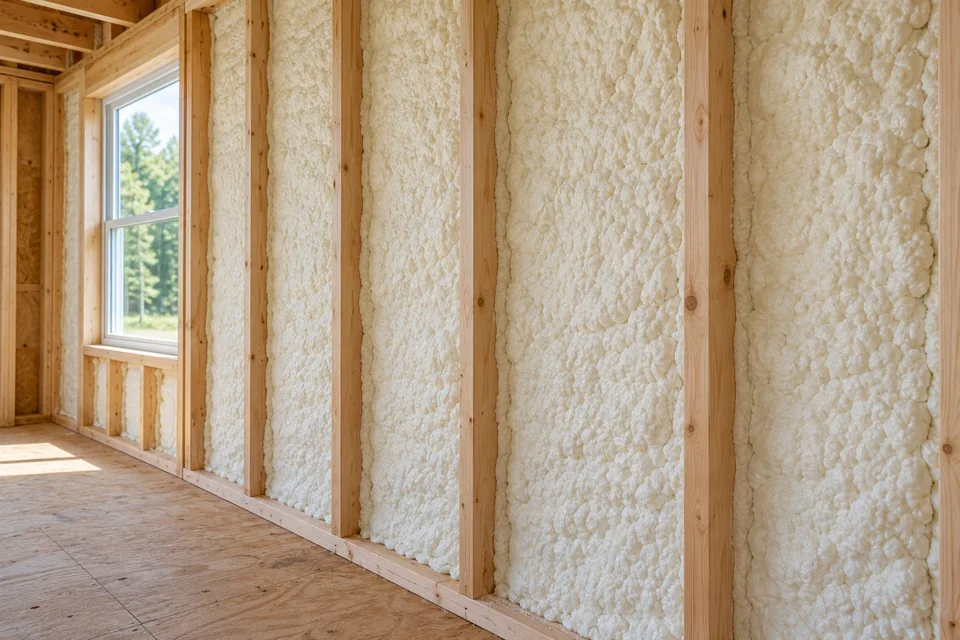
Sprayed foam suits open or accessible stud bays, where it can insulate and air-seal the cavity. Both open-cell and closed-cell foam can do this; closed-cell generally provides more thermal resistance per inch, while open-cell is more vapor-permeable.
Finished walls are a different project. The cavity must be opened, or a different injection system may be considered. Avoid assuming no demolition is needed; the estimate should state how access will be created and restored.
Plan access, moisture control and finish
- Wall type and cavity depthnote whether walls are framed, masonry, plaster or drywall, and whether the stud bay is empty or already insulated.
- Access plandecide which rooms or exterior sections can be opened, and how trim, siding, wiring and plumbing will be protected.
- Moisture and vaporask how the wall assembly will manage moisture in a colder climate. Hybrid systems and vapor-retarder placement need moisture-aware design.
- Fire protectionfoam is combustible, and required protective barriers depend on the assembly, product approval, occupancy and adopted code.
What a Wall Foam Scope Should Itemize
| Project detail | What to confirm |
|---|---|
| Areas and access | Which walls, rooms or elevations are included, and how the cavity will be opened and closed. Access should be stated, not implied. |
| Foam product and thickness | Exact product, open-cell or closed-cell, and target thickness. Published properties are product-specific. |
| Prep and protection | Masking, removal of old insulation, protection of wiring, plumbing and finishes, plus cleanup expectations. |
| Protective finish | Whether exposed foam needs a code-approved barrier and what patching, drywall or trim work is included. |
How to Prepare a Useful Wall Insulation Estimate Request
Ask for a written scope that names the product, thickness, access method and finish repair.
- From safely accessible areas, photograph the walls from inside and outside if safely possible, including any cracks, stains or prior insulation.
- List the rooms that feel coldest or draftiest, and note whether you are planning renovation work that would open the walls.
- Note any known moisture, wiring or plaster conditions. Ask how the assembly will manage vapor and how exposed foam will be protected.
A FEW MORE ANSWERS
Questions before you get started
Can you insulate finished walls without removing drywall?
Sprayed foam needs an accessible cavity. Finished walls require an access decision, and injection foam is a different system. Do not assume no demolition.
Open-cell or closed-cell for walls?
Both can insulate and air-seal. Closed-cell generally has more thermal resistance per inch; open-cell is more vapor-permeable. Assembly and moisture design decide suitability.
Does wall foam need a protective covering?
Foam is combustible. Required barriers depend on product approval, assembly, occupancy and adopted code. Ask what is required for your wall.